

Medical Timeline and Causation Summary
Michael A. Stuart – Spine Treatment and Subsequent Disability
Overview
This case arises from a sequence of medical events beginning in 2021, when Plaintiff was referred by the Dallas VA to UTSW neurosurgery for management of a lumbar spine condition. The VA referred Plaintiff to UTSW under its Community Care program and advised that UTSW would oversee Plaintiff’s spine treatment going forward.
The treatment pathway that followed included:
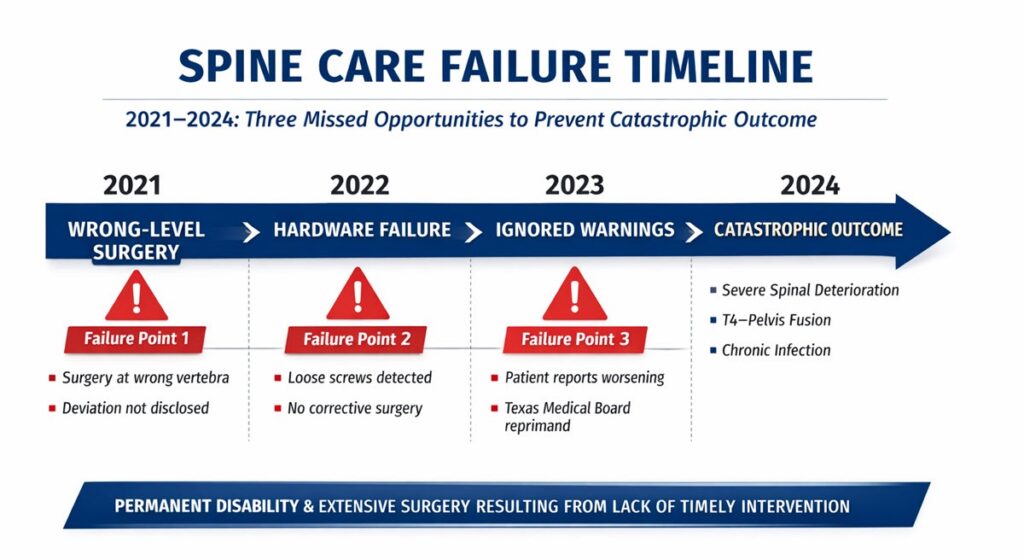
- a surgery performed on the wrong vertebral level,
- a hardware failure identified months later, and
- two years during which the failed surgery and worsening condition were not corrected despite repeated opportunities to intervene.
The VA later determined that Plaintiff suffered additional disability related to the medical care provided and granted compensation under 38 U.S.C. §1151.
While the VA accepted responsibility within its administrative system, the events that led to Plaintiff’s catastrophic spinal deterioration involved actions and omissions by UTSW providers responsible for evaluating and managing the condition after the original surgery.
Chronological Medical Timeline
Early 2021 – VA Referral to UTSW
Plaintiff was referred by the Dallas VA to UT Southwestern Medical Center neurosurgery for evaluation and management of a lumbar spine condition.
The VA advised Plaintiff that UTSW would take over oversight of his spine treatment because of the close working relationship between the institutions and UTSW’s neurosurgical expertise.
The treatment plan discussed at that time was a limited L2–L4 spinal fusion.
At this stage, Plaintiff’s condition involved a localized lumbar problem and did not involve the catastrophic spinal deterioration that later occurred.
September 2021 – Wrong Vertebral Level Surgery
In September 2021, spinal surgery was performed that deviated from the planned surgical level.
The surgery was later determined to have been performed at the wrong vertebral level, a deviation from the surgical plan that was not disclosed to Plaintiff at the time.
The failure to inform Plaintiff of this deviation was later the subject of disciplinary findings by the Texas Medical Board.
This event represents the first key failure in the chain of events leading to Plaintiff’s injury.
Key failure #1
Failure to disclose and address a wrong-site / wrong-level surgery immediately after the operation.
Had this error been disclosed and addressed promptly, corrective surgery could likely have been performed before further structural damage occurred.
March 2022 – Hardware Failure Identified
By early 2022, imaging revealed that the surgical hardware placed during the 2021 procedure had failed, including loose pedicle screws.
A neurosurgeon at UTSW reviewed the situation and indicated he would attempt to obtain the VA CT scan to evaluate the condition.
UTSW had historically conducted its own imaging studies for this patient but did not pursue corrective intervention at this time.
This moment represents the second major opportunity for corrective treatment.
Key failure #2
Failure to act on clear imaging evidence of hardware failure and failed fusion.
Timely revision surgery at this stage could have stabilized the spine before the condition deteriorated further.
2022–2023 – Continuing Deterioration Without Intervention
During this period:
- UTSW continued to receive VA Community Care referrals for Plaintiff.
- Dr. Patel requested an additional extension of the Community Care authorization, indicating ongoing management of Plaintiff’s spinal condition.
Despite this continuing relationship, no corrective treatment was initiated.
The VA continued to perform imaging studies during this period but did not intervene because it believed UTSW was overseeing the patient’s spine care.
This period represents a prolonged failure of care coordination and treatment.
June 2023 – Formal Notice of Surgical Issues
In June 2023, Plaintiff directly informed Dr. Patel and UTSW providers that:
- the Texas Medical Board had disciplined the surgeon involved in the 2021 surgery for failing to inform the patient of the surgical deviation, and
- Plaintiff’s condition had significantly deteriorated.
This communication placed UTSW on explicit notice that the surgical outcome had been compromised and that Plaintiff’s condition was worsening.
Despite this notice, corrective treatment was not initiated.
Key failure #3
Failure to intervene even after being notified of:
- a regulatory finding related to the surgery, and
- Plaintiff’s severe deterioration.
VA Administrative Findings
After reviewing the medical history and resulting disability, the VA granted compensation under 38 U.S.C. §1151.
A §1151 determination means that the VA concluded the veteran suffered additional disability caused by medical care within the VA treatment system.
The VA’s decision provided administrative compensation for the resulting disability.
However, the VA determination does not address the separate issue of responsibility for the underlying medical failures that led to Plaintiff’s catastrophic spinal deterioration.
Resulting Medical Consequences
Because the surgical error and hardware failure were not corrected when they were first identified, Plaintiff’s spinal condition continued to deteriorate.
By 2024, Plaintiff required extremely complex reconstructive spinal surgery, ultimately resulting in:
- fusion of the spine from T4 to the pelvis,
- severe loss of spinal mobility, and
- permanent disability.
During the extensive surgeries required to repair the spinal damage, Plaintiff also developed a Pseudomonas infection, a serious complication associated with complex spinal reconstruction procedures.
This infection has required prolonged treatment and continues to affect Plaintiff’s health.
Causation Summary
The catastrophic outcome experienced by Plaintiff was not the inevitable result of the original condition.
Instead, the outcome followed a sequence of identifiable failures:
- Wrong-level spinal surgery in 2021 that was not disclosed or corrected.
- Hardware failure identified in 2022 that was not treated despite imaging evidence.
- Failure to intervene during 2022–2023 while UTSW continued to manage Plaintiff’s spine care under VA Community Care referrals.
Because the failed surgery was not corrected when the problem was first identified, Plaintiff’s spinal instability progressed until extreme reconstructive surgery became necessary.
Those surgeries ultimately resulted in the permanent spinal fusion and complications that now define Plaintiff’s disability.
Relationship Between VA Compensation and UTSW Responsibility
The VA’s decision to grant benefits under 38 U.S.C. §1151 reflects the federal government’s administrative recognition that Plaintiff suffered additional disability from the medical care provided within the VA treatment system.
However, that administrative compensation does not determine the separate legal responsibility of the providers whose actions or omissions contributed to the underlying medical failure.
The evidence shows that UTSW providers had multiple opportunities between 2021 and 2023 to recognize and correct the failed surgery before the condition progressed to catastrophic spinal collapse.
Their failure to act during those critical periods allowed the condition to deteriorate until extreme reconstructive surgery became unavoidable.