

If you’ve been following my journey, you know I’ve spent the last several years fighting two relentless battles: one against a severe, life-threatening spinal infection, and another against the massive bureaucracy of the Department of Veterans Affairs (VA) and the U.S. Department of Justice (DOJ).
I wanted to share a plain-English update on where my federal court case stands, what I’m asking for, and what lies ahead.
The Backstory: How We Got Here
In August 2021, I underwent spinal fusion surgery through VA Community Care. Just two months later, an October 2021 CT scan clearly showed that the surgical hardware in my lower back was loose.
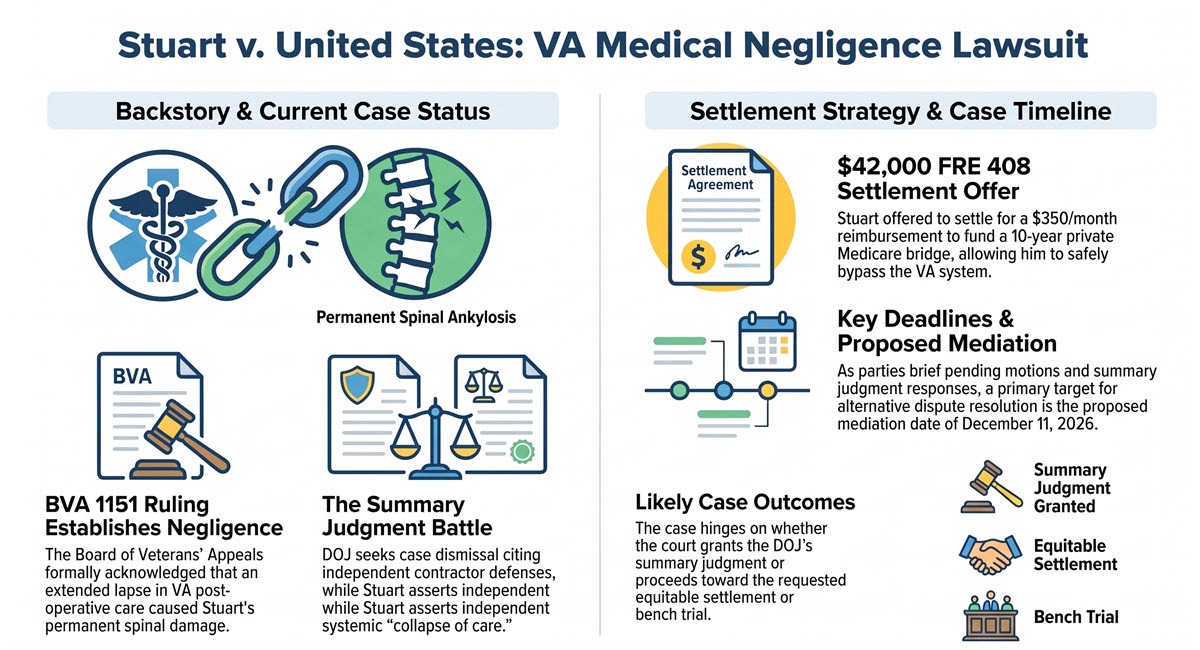
Despite my worsening pain and crippling mobility loss, VA staff ignored that CT scan and failed to coordinate my care for over two full years. By the time private surgeons at Baylor Scott & White opened my back in 2024 to rebuild my spine from my T4 vertebra down to my pelvis, they discovered something horrifying: an active, hardware-embedded Pseudomonas bone infection and roughly 400 cc of purulent material (pus) trapped in my spine.
In December 2025, the Board of Veterans’ Appeals (BVA) officially ruled in my favor under 38 U.S.C. § 1151. The Veterans Law Judge explicitly found that my permanent spinal disability was caused by the VA’s “extended and unexplained lapse in post-operative care.”
Where the Federal Case Sits Today
Even with that official VA finding of negligence, the DOJ filed a Motion for Summary Judgment asking the federal court to throw out my lawsuit on technicalities—claiming I didn’t hire a testifying medical expert and trying to shift blame to outside contractors.
On September 8, 2026, I officially filed my response on the court docket (Document 58). My argument to the judge is simple and common-sense:
- Direct VA Negligence: This lawsuit is about federal VA employees who failed to pull my medical records, reconcile my CT scans, or manage my care as a Priority Group 1 disabled veteran.
- Common Knowledge: Under Texas law, you don’t need a medical degree or a paid expert witness to know that ignoring loose metal screws in a human spine for two years is negligence.
- The 1151 Ruling Speaks for Itself: A federal judge has already officially ruled that the VA’s lapse in care crippled my spine.
My Settlement Offer: I Am Not Seeking a Windfall
Alongside my court response, I sent a formal settlement offer under Federal Rule of Evidence 408 to Assistant U.S. Attorney Tami Parker.
I made my position crystal clear: I am not looking to get rich, drag out litigation, or chase millions of dollars in damages. I am even waiving recovery for the $1,000-a-month HUD-VASH housing voucher I permanently lost during this crisis.
All I am asking the government to do is reimburse $350.00 a month for my private Medicare Supplement (Plan G and Part D) coverage.
Because the local VA clinic remains completely “blind” to my private surgeries and chronic bone infection, this $350-a-month insurance is literally the private medical shield that keeps me alive and under specialist care. When you consider that the VA routinely pays private hospitals tens or hundreds of thousands of dollars for Community Care, paying $350 a month to keep a severely disabled veteran alive is a drop in the bucket.
What’s Next on the Legal Calendar?
- September 28, 2026: The DOJ’s deadline to file their final Reply Brief on summary judgment.
- October 2026: Magistrate Judge David L. Horan will review all arguments and issue his recommendation to the court.
- December 11, 2026: The hard deadline for formal, court-ordered mediation between myself and the United States.
Final Thoughts
This fight has never been just about legal filings; it’s about accountability, survival, and standing up for veterans who get lost in a broken system. I’ve put the complete, black-and-white truth on the court record, and I’ve offered the government a fair, compassionate way to settle this case.