
What this article covers
- The 20% Infection Grant: Explains the VA decision granting service connection for chronic Pseudomonas aeruginosa bone/hardware infection.
- The “VA Math” Progression: Outlines how the 20% grant moves the unrounded score from 78.9% to ~83.1%, 1.9 percentage points away from the 85.0% threshold for 90% schedular pay.
- The Legal Framework (38 C.F.R. § 3.310): Establishes how service connection for the infection legally anchors long-term Ciprofloxacin suppression as service-connected treatment.
- Secondary Cipro Toxicity Claims: Summarizes the medical rationale connecting continuous Cipro therapy to Chronic Fatigue / Mitochondrial Toxicity, Aggravated IBS-C, and Structural Dental Failure.
How a Rating Increase could Springboard into more Compensation
On October 23, 2026, the Department of Veterans Affairs issued a decision officially granting service connection for Chronic Pseudomonas aeruginosa spinal implant-associated infection at a 20% disability evaluation. While a 20% grant on a major bone infection may sound modest at first glance, this ruling establishes a critical legal anchor for my overall VA claim strategy.
The “VA Math” Impact: Closing the Gap to 90%
Under the VA’s whole-person combined rating system, disability percentages are calculated against a veteran’s remaining healthy body rather than added together directly. Before this decision, my combined rating sat at a raw 78.9% (which rounded up to 80% compensation).
Adding the new 20% Pseudomonas rating takes 20% of my remaining 21.1% healthy body, raising my raw combined score to ~83.1%. While 83.1% still rounds down to 80% on my monthly check today, it accomplishes something vital: it moves my baseline to within 1.9 percentage points of the 85.0% threshold required to round up to a 90% monthly payout.
The Legal Anchor: 38 C.F.R. § 3.310 and Treatment Side Effects
The true significance of this grant is legal, not just numerical. Under 38 C.F.R. § 3.310, any new disability or aggravation caused by medically necessary treatment for a service-connected condition is compensable as a secondary service-connected disability.
Because the VA has officially recognized my chronic Pseudomonas bone infection as service-connected, the 30+ months of continuous daily Ciprofloxacin (fluoroquinolone) antibiotic therapy required to suppress the organism are now legally recognized as treatment for a service-connected condition. This directly opens the door to claim all secondary disabilities resulting from long-term Cipro toxicity.
Setting the Stage for New Secondary Cipro Toxicity Claims
Using our infectious disease records and pharmacological literature, we are preparing three new secondary claims directly tied to long-term Ciprofloxacin suppression:
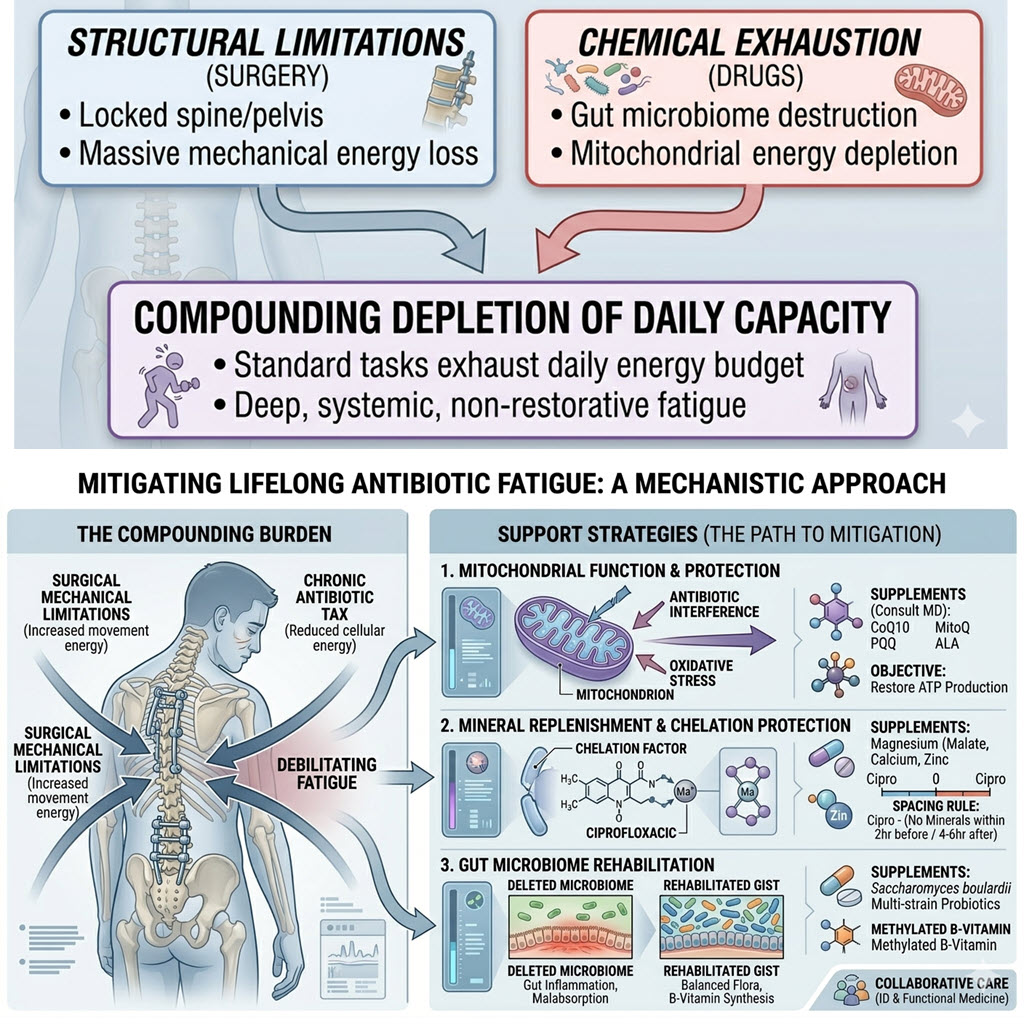
- Chronic Fatigue / Mitochondrial Toxicity: Fluoroquinolones directly impair cellular mitochondrial function, disrupting ATP energy synthesis. This causes severe, crashing daily fatigue and exhaustion that cannot be overcome by rest.
- Aggravated IBS-C: Over two years of daily heavy antibiotic use has devastated my gut microbiome, causing gastrointestinal motility disruption and severe chronic constipation (IBS-C) requiring daily prescription management.
- Structural Dental Failure: Ciprofloxacin chelates essential calcium and magnesium ions—stripping mineral integrity from enamel and dentin—while upregulating enzymes (MMP-2 and MMP-9) that break down Type I collagen. This biochemical breakdown has caused severe tooth brittleness and spontaneous fractures at the gumline, establishing a direct link for Class IV VA Dental Coverage.
The Path Forward
By establishing service connection for the underlying Pseudomonas infection, the VA created the exact evidentiary bridge needed to link my systemic fatigue, gastrointestinal damage, and dental failure directly to my service-connected care. Filing these secondary claims will easily push my 83.1% baseline past the 85% mark for 90% schedular pay while reinforcing the complete medical rationale for Total Disability Based on Individual Unemployability (TDIU).