

Introduction
How does a routine back surgery escalate into a federal lawsuit involving a drug-resistant bone infection, years of suppressive therapy, and intense legal scrutiny?
Through the lens of Michael Stuart v. United States of America, we will explore how medical complications transform into federal legal disputes and how the discovery process exposes the critical facts of a case.
Learning Objectives
By the end of this report, you will be able to:
- Explain the purpose and mechanics of the Federal Tort Claims Act (FTCA) in medical malpractice litigation.
- Distinguish between Requests for Production (RFPs) and Interrogatories in civil litigation.
- Identify the key medical diagnoses and management strategies for spinal hardware infections, specifically Pseudomonas aeruginosa discitis and osteomyelitis.
- Analyze how clinical timelines and medical records serve as foundational evidence in a legal dispute.
The Legal Framework: Suing the Government
When a patient alleges medical malpractice at a facility run by the federal government—such as a Department of Veterans Affairs (VA) hospital—they cannot simply file a standard civil lawsuit. Instead, they must navigate the Federal Tort Claims Act (FTCA).
Under sovereign immunity, the U.S. government cannot be sued without its consent. The FTCA acts as a limited waiver of this immunity, allowing individuals to sue the United States for personal injury caused by the negligent acts of government employees acting within the scope of their employment.
In our case study, Michael Stuart v. United States of America (Civil Action No. 3:25-cv-00198-X-BN in the Northern District of Texas), the plaintiff is a pro se veteran (representing himself) suing the government. He alleges that the VA failed to provide timely and adequate care following a failed spinal fusion surgery, leading to severe subsequent complications.
View slide deck on Sovereign Immunity & the FTCA
The Discovery Phase: Building the Evidence
Once a lawsuit is filed, both parties enter the discovery phase. This is the formal process of exchanging information, documents, and facts to prevent surprises at trial and encourage fair settlements. The two primary tools used in this phase are:
- Requests for Production (RFPs): Governed by Federal Rule of Civil Procedure 34, these require a party to hand over physical or digital evidence, such as medical records, emails, diaries, and even physical mobility devices.
- Interrogatories: Governed by Rule 33, these are written questions that the receiving party must answer truthfully under oath.
In this lawsuit, the government’s defense attorney, an Assistant United States Attorney, sent Stuart extensive RFPs and Interrogatories. The government demanded details regarding every doctor he saw, every medication he took, any diaries or timelines he kept, and even evidence of his past ten years of employment earnings to challenge his claims of lost earning capacity.
The Medical Reality: Spinal Infections and Hardware Failures
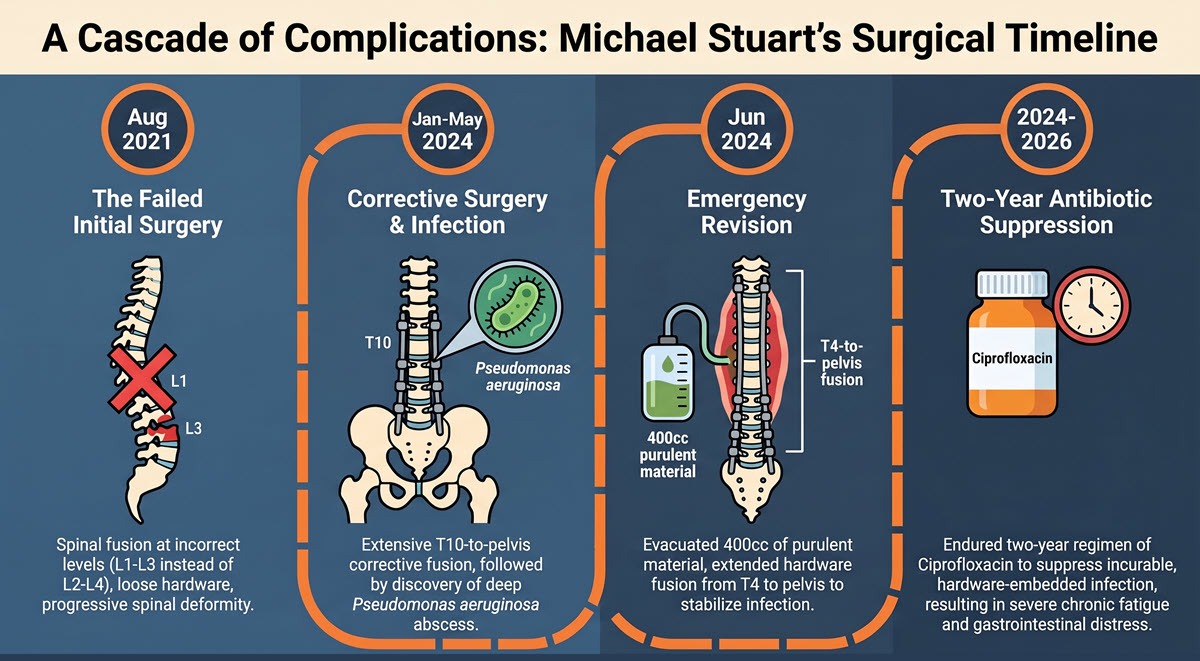
The heart of Michael Stuart’s lawsuit lies in his complex medical history. A review of his infectious disease records reveals a dramatic timeline:
- August 2021: Initial laminectomy (spinal surgery to relieve pressure on the spinal cord).
- January 2024: Anterior lumbar fusion surgery at levels L3-L4.
- June 2024: Admitted to Baylor University Medical Center with a severe spinal infection. Imaging showed a disc abscess and epidural tissue severely narrowing his spinal canal. Cultures of the wound fluid grew Pseudomonas aeruginosa, a highly resilient, opportunistic bacterium.
- June 7, 2024: Emergency revision surgery to remove infected spinal hardware from T10 to the pelvis, debride the infection, and place new instrumentation from T4 to the pelvis.
- June 2024 – July 2026: Stuart required intensive, long-term suppressive antibiotic therapy. He spent months on intravenous Cefepime through a PICC line, followed by over two years of daily oral Ciprofloxacin.
Did you know? Pseudomonas aeruginosa is notorious for forming biofilms on medical hardware like spinal screws and rods. These biofilms act as a protective shield, making the bacteria highly resistant to standard antibiotics and often requiring complete surgical removal of the hardware to cure the infection.
Evaluating Treatment Success: Objective Markers vs. Subjective Symptoms
In medical litigation, proving damages requires linking a provider’s alleged delay to objective clinical outcomes. Medical records from 2025 and 2026 highlight a classic clinical challenge: the discrepancy between objective lab markers and a patient’s subjective quality of life.
On the objective side, Stuart’s infection was eventually successfully controlled. By July 2026, his infectious disease specialist, Dr. Kevin Golden, noted that an MRI showed no active infection. His inflammatory markers—C-Reactive Protein (CRP) and Erythrocyte Sedimentation Rate (ESR)—had returned to completely normal levels (CRP of 1 mg/L and ESR of 20 mm/hr).
Subjectively, however, Stuart’s life was permanently altered. He suffered from severe, ongoing peripheral neuropathy (reporting only 40% nerve function in his feet), chronic back pain, and profound fatigue and digestive issues caused by the years of heavy antibiotic use. These lingering physical limitations form the basis of his claim for damages, including loss of daily activity and physical impairment.
Key Takeaways
- The FTCA Route: Anyone alleging malpractice at a federal medical facility (like the VA) must sue the United States government under the strict guidelines of the Federal Tort Claims Act.
- The Power of Discovery: RFPs and Interrogatories are powerful legal mechanisms that force the disclosure of medical histories, communications, and financial records to establish or refute claim validity.
- Biofilm Challenges: Bacterial infections involving spinal hardware (like Pseudomonas aeruginosa) are difficult to treat, often requiring invasive hardware removal and multi-year suppressive antibiotic regimens.
- Objective vs. Subjective Damage: Even when clinical laboratory results (like CRP and ESR) show that an infection has been cured, a patient may still experience devastating, permanent nerve and functional impairments that serve as the focus of a damages claim.